


We independently review every app we recommend in our best apps lists. When you click some of the links on this page, we may earn a commission. Learn more.
Forms have a reputation problem. Most people think they’re just for getting feedback and collecting contact info, but forms are a great tool for other reasons: you can help customers submit support tickets, sign them up for an event, or even help your employees request new hardware for their departments.
Having an excellent form builder will help you create the forms you need to handle all these use cases—and more—while staying true to your brand image, keeping track of submissions, and understanding how to improve data collection as you go.
With so many online form builders to choose from, it’s hard to know where to start. So I started for you: I considered nearly 100 form builders and did in-depth testing on dozens of them. From all that research and testing, here are the best tools to build your online forms.
The best online form builder apps
What makes the best form-building software?
How we evaluate and test apps
Our best apps roundups are written by humans who’ve spent much of their careers using, testing, and writing about software. Unless explicitly stated, we spend dozens of hours researching and testing apps, using each app as it’s intended to be used and evaluating it against the criteria we set for the category. We’re never paid for placement in our articles from any app or for links to any site—we value the trust readers put in us to offer authentic evaluations of the categories and apps we review. For more details on our process, read the full rundown of how we select apps to feature on the Zapier blog.
Form apps let you build a form you can share with others, including a range of question types and input fields that allow you to gather any kind of information you need. At the bare minimum, these platforms will let you line up all your questions, share them quickly, and see a simple list of responses. More advanced form software includes analytics features, form access controls, AI-generated elements, and powerful reporting to give you more control and insight into each submission.
As I was testing, here’s what I looked for in each form builder app:
-
Ease of use. The best form builder apps should be easy to pick up and intuitive to use, without having to read the entire help center.
-
Design and customization. Whether you’re looking for consistent branding across channels or a more creative solution to drive engagement, your forms app should give you the tools to do so.
-
Versatility. You likely have at least a few use cases for using forms—you should be able to use the same tool to build feedback forms, lead generation forms, email embeds, and pop-up forms.
-
Powerful analytics tools. Here, I was looking at analytics (the metadata generated for your forms) as well as the quality and variety of reports (for the content your respondents enter on the form).
-
Extra features. I valued anything that improves the user experience, adds further integration and automation opportunities, or gives you better insight into the data collection process. Think things like AI and the option to accept payments or eSignatures through your forms.
I signed up for each form maker and created a couple of forms, using templates as a base and running a prompt through the AI builder where available. I filled them out with sample data, and then ran some reports to see how detailed they were. When there were unique features, I also tested those to see if they were easy to use and if they added value to the experience.
Before I dive in, a few other notes:
-
This list focuses on the best online form builders to get the job done, regardless of price. If you’re looking for free options, take a look at Zapier’s roundup of the best free survey tools and form builders or the best Google Forms alternatives.
-
If you want a specialized tool for surveys (which generally means things like question banks and analytics), then be sure to check out the best survey apps.
-
If you use WordPress and are looking for a form builder plugin, take a look at Zapier’s list of the best WordPress form plugins.
-
If you’re already using database or project management tools like Airtable or Asana, you might already have form-building features built in. Give them a quick test to see if they match your needs before you spring for a new app.
The best online form builders at a glance
|
Best for |
Standout features |
Pricing |
|
|---|---|---|---|
|
Google Forms |
Quickly creating powerful forms for free |
Very easy to use; part of the Google software suite |
100% free |
|
Zapier Forms |
Automation |
Built-in database with Zapier Tables; built for automation |
Free plan available; paid plans from $19.99/month (billed annually) |
|
Jotform |
Starting from a template |
Plenty of widgets and question types; advanced code customization available |
Free plan available; paid plans from $39/month |
|
Typeform |
Conversational forms |
Awesome user experience; step-by-step help available for embedding your forms |
Free plan available; paid plans from $39/month |
|
Formless |
A formless AI experience |
New data collection experience for your respondents; easy building process |
Plans from $59/month |
|
Fillout |
Building a form with AI |
Extremely versatile; payment forms available via Stripe integration |
Free plan available; paid plans from $19/month |
|
Microsoft Forms |
Real-time sync with Excel |
Easy to use; has a few advanced features for free |
100% free |
|
Zoho Forms |
Approval flows |
In-depth submission reports |
Free plan available; paid plans from $12/month |
|
Paperform |
Creating order forms |
Great design out-of-the-box; connects with Google’s and Facebook’s analytics tools |
Free plan available; paid plans from $29/month |
|
Tally |
A doc-style form-building experience |
Native integration with Notion; doc-like builder |
Free plan available; paid plans from $29/month |
|
forms.app |
Teams |
Granular user access controls |
Free plan available; paid plans from $29/month |
|
Youform |
A free Typeform alternative |
Conversational forms; AI logic builder |
Free plan available; paid plans from $29/month |
Best free online form builder for quickly creating powerful forms
Google Forms (Web)

Google Forms pros:
Google Forms cons:
Google does it again. If you need to put together a useful form quickly, Google Forms is your best bet for getting the job done within the hour.
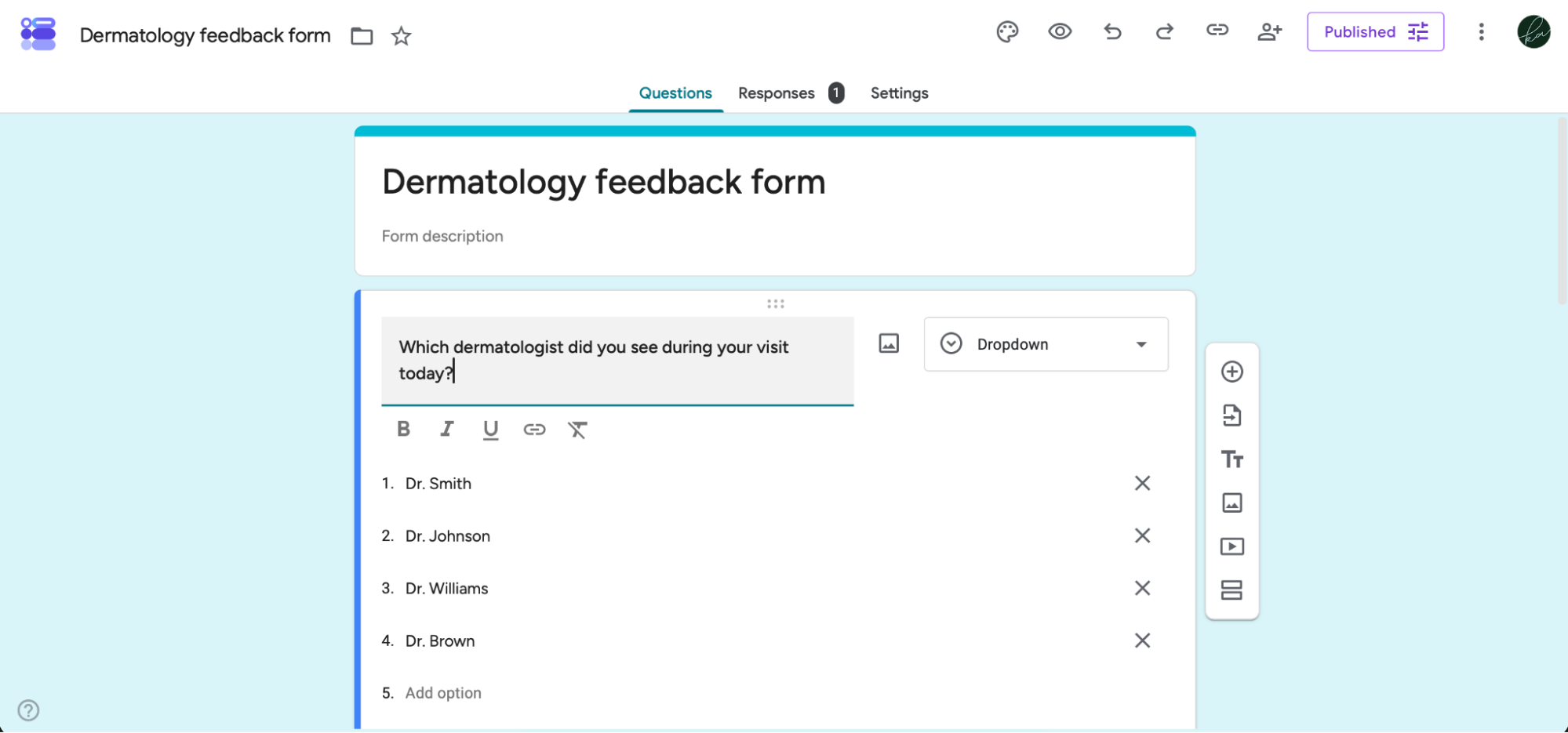
Building a form in Google Forms is easy and intuitive. You choose from 17 templates or build from scratch. Start typing your questions, and Google Forms can guess which question type it is, saving you a precious few seconds over choosing it from the dropdown menu. Even if this is your first time building a form, the result will look great. The simple controls help you stay on track and save time, but they prevent you from creating something unique if that’s what you’re looking for.
To speed things up even more, you can ask the AI to help you write questions. There aren’t any bells and whistles with the AI inside Google Forms, but it will build you straightforward questions without overcompensating like some AI builders do.
When you’re done, simply click the Send button, and choose to send it via email (either a link to the form or the entire form embedded in the body), copy a link to share manually, or embed the form as HTML on your site. When the responses start trickling in, you can see them in a list of aggregated data or individually, along with a collection of charts appropriate to the question type. If you’re a spreadsheet wizard, you can take this data to Google Sheets and look for deeper connections there.
In addition to that Sheets integration, you can also pre-fill a form to save your respondents some time, collaborate with others on your form, and browse a collection of add-ons on the Google Workspace Marketplace. Or save even more time by connecting Google Forms with Zapier to send your form data to other apps in your tech stack. Learn more about how to automate Google Forms.
Google Forms price: 100% free
Best online form builder for automation
Zapier Forms (Web)

Zapier Forms pros:
Zapier Forms cons:
You’re not a machine. So why do repetitive work every day when you can automate your data collection workflows and have more time to work on strategy? That’s what Zapier Forms is for.
Zapier Forms is the front door to automation. Every submission instantly launches workflows, updates systems, and keeps teams moving without manual steps or disconnected tools. And there’s no submission-based pricing, so you can scale as much as you need.
You can build your forms from scratch or use Zapier Copilot to automatically set up conditional logic, field mappings, and follow-up automations based on your intent. And unlike most other apps on this list, you can add multiple pages to each of your projects. Then, inside each page, you can drag and drop customizable components both for gathering and displaying data.
As you build out your forms, you’ll realize that your submissions need a place to live. That place is Zapier Tables, an automation-first data source with a generous free tier. While you can use Tables to view data, you can also quickly build a private Forms page to display that data and create filtered reports, ready to share with your team.
Once you get a form ready to collect responses, it’s time to integrate it with the apps you use for work. And here, there are so many setup options that it’s really up to how you configure your Zap workflows. You can move the data from Tables into an analytics app to get a big-picture view; you can pull data from your CRM to enrich each submission; you can run a simple decision-making tree using the conditional steps to see which clients are a best fit for your business. With connections to 9,000+ apps, it’ll work across your entire tech stack—and you can pull in the power of AI along the way, wherever you need it.
Configure once, reuse endlessly. And if you’ve got a tinkering itch like I do, you can keep improving these screens and Zap workflows over time. Forms is much more modular than other options in this list, meaning you can add or remove components and connections as your needs evolve. It can either be the main system on your tech stack or a support for streamlining parts of your work processes.
Zapier Forms price: Free plan available. Paid plans start at $19.99/month (billed annually).
Best online form builder for starting from a template
Jotform (Web, iOS, Android)

Jotform pros:
Jotform cons:
-
Free plan has limits on forms, submissions, views, and storage
Do you suffer from form builder’s block? Dread the blank (form) page? Jotform users don’t. With a massive form template library at your disposal, you can pick one of the 20,000+ templates available, from general use cases all the way to previously-unheard-of niches.
You can customize almost everything about your form’s design in the visual editor. And if that still doesn’t meet expectations, there’s an advanced editor to go deeper into it. Still not satisfied? Click on the CSS editor, and code all you want. It’s one of the most flexible apps on the list as far as design features go.
When sharing your form, Jotform offers all the same options as the competition, along with unique ones, like sharing as a fillable PDF, embedding an interactive feedback button on your website, and downloading the entire source code if you want to have your developers add a couple of extra features to it.
Maybe the most unique feature is the ability to present your form like a chat. Jotform provides you with an AI agent that you can train on information about your brand, your product, or anything you’d like to share with your respondents. Train it by copying and pasting text, sharing a website link, uploading a file, adding a Zendesk knowledge base, or simply giving it a question-answer guideline. To respondents, it’ll feel a bit more like they’re being engaged in a one-on-one conversation than filling out a traditional form.
As for extras, Jotform integrates with a wide range of payment platforms, lets you add widgets to your forms—such as embedding Instagram posts or gathering signatures with Jotform Sign—and you can even create an app from your forms, which your respondents can download and keep on their phones.
You can do even more with Jotform by connecting it to Zapier and sending the data you collect to where it needs to be. Learn more about how to automate Jotform.
Jotform price: Free plan available; paid plans start at $39/month
Best form app for conversational forms
Typeform (Web)

Typeform pros:
Typeform cons:
Typeform is synonymous with conversational forms: forms that show questions card by card, one at a time. The user experience is so polished and powerful that your form respondents can ditch their mouse and reply to forms using only their keyboard.
To start, you can build from scratch, import questions, create with AI, or sync to HubSpot. If you pick the AI option, you can feed it a completely custom prompt, upload files as context, and connect information from a handful of connected apps.
The builder interface is equally elegant, uncluttered, and easy to use. There are a lot of visual assists and tooltips to guide you as you build, and it’s nearly impossible to make a form that doesn’t look great. You can start from 1,500 form templates and style them with more than 50 design themes. And you can tweak the design by switching up the question card layouts, fonts, icons, and alignments. I like that you can also check for accessibility issues, such as making sure there’s enough contrast between your background and the question text.
When the responses start piling up, you can see them as the classic submissions list, view charts based on question type, and generate rich reports that you can share via link. One unique option is the ability to tag submissions, letting you organize them by your own categories, or even attach tasks if a response needs you to do something about it. Other analytics include conversion rate, time to complete, and where people usually give up on filling out the form.
A handy extra you’ll find in Typeform—and one that speaks to its focus on aesthetics—is the ability to add your brand kit to the platform. Your forms will stay consistent no matter where you share them.
You can also connect Typeform to Zapier, making sure all your Typeform data gets to where you want it, and even sending out automated follow-ups. Learn more about how to automate Typeform.
Typeform price: Free plan available; paid plans start at $39/month
Best online form builder for a formless AI experience
Formless (Web)

Formless pros:
Formless cons:
Formless takes the concept of AI-powered conversational forms to a new level. This Typeform product thrives entirely on breaking the structuring of the traditional form-building experience. This means no need for juggling question types, input fields, or form sections. Instead, you’ll be using prompts most of the time.
You can take a virtual tour or watch a tutorial video to learn how to use the app, but it’s very easy to pick up. On top of using AI to generate a form, you can create from scratch or use any of the eight templates to engage inbound leads, get feedback, calculate quotes, and even create job applications/answer candidate questions.
If you go with the “from scratch” or AI option, you’ll start by adding the purpose of the form to anchor the AI on the task at hand. Then, pick which tone of voice best fits your brand. There’s an indicator of how chatty each of them is—and it’s no wonder that sassy and energetic types generate more words, right?
With the personality locked in, the next important step is Journey. Here, you’ll list all the topics you want to ask about. The coolest part is how you can write every aspect of your question in natural language, and Formless will understand what the question type is, dynamically offering it to your respondents—conditional logic included. For example, if you say “if the customer talks about product A instead of product B, ask why they didn’t choose product B,” Formless will apply that rule in the conversation—no extra configuration required.
Since this is almost a chat experience, this form can double as a simple customer support tool. You can train the AI with snippets or documents to add information about your products and services. Whenever a user asks a question at any time, they’ll get an instant answer. And if your AI form hasn’t finished all the Journey questions, it’ll find a way to tie it back in and get to the end.
After a conversation is inactive for eight minutes, you’ll get the new data in your Analytics tab. And if you love drilling into voice of customer data, head over to conversation transcripts to mine questions and the writing style of your target audience. You’ll get an AI-generated summary of how each individual responded with their overall sentiment, plus the key info from their responses filtered out, and a full transcript of the chat. You can move these insights into your other work apps too. Just connect Formless to Zapier, and start automating.
Formless price: Paid plans start at $59/month
Best online form builder for building a form with AI
Fillout (Web)

Fillout pros:
Fillout cons:
Love traditional forms but not the building process? Take the artificially intelligent shortcut with Fillout, a simple form builder with a generous free plan and a great range of integrations.
When starting a new form with AI, you can either use a prompt, drop a URL, or upload a PDF. The AI-generated questions are on-point (with a small caveat: I asked it to create a rating question that ranged from 1-5 and it provided 1-10).
Beyond the AI features, designing a good-looking form is easy, as the controls strike a good balance between simplicity and power. You can choose from a number of preset themes, edit typography, colors, and the basic layout. The interface itself has a set of colorful buttons to help you distinguish each question type, something that helps guide your eyes and understand what you can do on each screen.
Once you’re done editing your form, you can polish it a bit more before sharing. You can add and customize cover and ending pages to give your audience a better user experience. If you want to sell something, you can add a payment page to make the transaction on the form. And there’s a built-in scheduler that connects to Google Calendar and is available on the free plan. If you upgrade to a paid plan, you can even build a login page, so your respondents can create accounts and access protected information.
And while Fillout has a deep integration with Notion, Airtable, and Google Sheets, you can also connect it to Zapier, adding support for thousands more apps. Learn how to automate Fillout.
Fillout price: Free plan available. Paid plans start at $19 per month.
Quill Forms is another strong option for building forms with AI. The app’s AI form builder is currently still in beta, but it worked well during my testing. Quill users can also accept payments, choose from 19 form field types, and add conditional logic—and the pricing is on par with Fillout.
Best free online form builder for real-time sync with Excel
Microsoft Forms (Web, Windows)

Microsoft Forms pros:
Microsoft Forms cons:
Microsoft Forms isn’t a household name like many other Microsoft apps, true. But this free online form creator is intuitive, and it plays well with Excel, offering real-time sync: any time a new submission is saved, it gets passed to your connected spreadsheet right away. Like Google Forms, it focuses on getting a good form in the hands of your audience as fast as possible.
It definitely feels like a Microsoft product, so if you’ve been using Microsoft apps for a long time, you’ll get the gist of the navigation quickly. It starts you off with four scenario options: Survey, Quiz, Invitation, or Registration. Once you pick one, you get access to about 12+ templates per category. Since it’s a free tool, you get very few question types (only eight).
The default is to draft a new form via Copilot. You can enter a custom prompt or choose from a handful of sample ones.
Deleting questions or adding additional fields is easy, and you can edit the settings on any of them by hovering and clicking the appropriate button in a WYSIWYG editor. If some of your answers require specific inputs—e.g., only let people over 65 years old submit the form—you can set up these input validation settings on each question.
When you click the Style button, you’ll be able to see AI-powered theme suggestions. Click on a color or background image below, and the themes will update based on that choice. Some even have animated backgrounds, giving a touch of life to your form—beware of those with fast-moving graphics, though.
As far as distribution, you have the usual options: send a link or QR code, share via social media, or embed using HTML. But you can also send an email directly from Microsoft Forms—it’ll craft the email for you, and all you have to do is input the recipient’s address.
Microsoft Forms is free, but you need to log in to your free Microsoft account before visiting the link (it might ask you to subscribe to a Microsoft 365 plan if you’re not already logged in).
Microsoft Forms price: 100% free
Best online form builder for approval flows
Zoho Forms (Web, iOS, Android)

Zoho Forms pros:
Zoho Forms cons:
Zoho Forms is part of the Zoho software suite, which means it thinks at an organizational level. You can add your coworkers or other stakeholders to the app and share forms with them quickly, tracking submissions and requests in a single place.
If you work at a large company, you know that some requests may have to be approved by multiple people. Zoho Forms gets this. It lets you create approval flows, a set of rules on how to escalate requests. Let’s say you have an asset request form. If there’s more than one manager involved in the decision-making process, you can route the request form through the direct supervisor first. If that supervisor approves, it goes to the next manager in the hierarchy, and so on—until it’s green-lit or refused.
You can pick from 100+ form templates. Once you tweak the questions to your needs, there are tons of themes to make it look good (and on brand). Zoho Forms comes with a dedicated visual form editor, where you can edit pretty much anything in your form’s layout. I also love the ability to create multiple column sections within the form. Most apps just have one question stacked beneath the previous, but Zoho Forms gives you much more flexibility when it comes to structure.
The reports section is also robust, letting you see a list of results and allowing you to build your own reports by setting question/answer filters and showing/hiding questions. In addition to tracking IPs and geolocation, you can also track source traffic through UTM, URL parameters, and Google Analytics.
To streamline things even more, you can connect Zoho Forms with Zapier, so your form responses end up where you want them. Learn more about how to automate Zoho Forms.
Zoho Forms price: Free plan available; paid plans start at $12/month
Best online form builder for creating order forms
Paperform (Web)

Paperform pros:
Paperform cons:
Paperform in three words: beautiful, clean, and sleek. The most attractive possibility here is how you can create and manage forms to take orders and make sales.
When you create a form, add a Products section, then input what you’re selling. You can add the name, SKU, image, price, minimum and maximum quantities, as well as the total available stock. You can even import your product list as a CSV file to save some time.
There’s coupon support and custom pricing rules if, for example, you want to add an extra to each sale to offset the payment platform costs. Paperform integrates with Stripe, PayPal, and Square to help you process those transactions.
You can create forms from scratch, use AI, or go with a template. I love the huge variety of niche templates to choose from, including donation forms, travel forms, church forms, and even random trivia quiz forms. Creating a new form is like creating a document. You add blocks with headers, images, or descriptions, and then the input fields. As you build, you see exactly what your users will see in the end result. To change the settings on a block, just hover over it, and click the cog.
The AI builder works well. What’s unique here: I love that the AI asks smart, contextual follow-up questions based on your prompt to ensure it has all the context it needs—meaning the first draft is a lot closer to what you really need than most other apps out there.
Paperform has the basic reporting features and analytics, and it integrates with Google Analytics and Meta Pixel to help increase your sales based on that intel. You can connect it to even more tools by using Paperform’s Zapier integration to get your data where you need it, across 9,000+ apps. Learn more about how to automate Paperform.
Paperform price: Free plan available; paid plans start at $29/month
Looking for an alternative with form encryption? Take a look at Formsite (which is powered by Formstack)—it offers high data security features at a lower price point.
Best online form builder for a doc-style building experience
Tally (Web)

Tally Pros:
-
Unlimited forms and responses for free
-
Great for doc-style editing
-
Free conditional logic and scoring
Tally Cons:
At first glance, Tally might come across as a little intimidating as a form builder, given it doesn’t fit the typical look of a platform for creating forms. It actually looks like a doc—and it kind of works like one, too.
But Tally is very good at providing simple instructions to get new users started and comfortable with the platform. When you’re creating your first form, it’ll prompt you to hit the / button to insert a question type (e.g., short answer, multiple choice, a linear scale). Once you choose an option, Tally takes it from there by inserting all the placeholder elements for the question, so all you need to do is customize it with a specific question and answers.
You can also customize the design and layout to your heart’s content with the ability to change the basics, like background or button colors, and the more advanced aspects, like page width and margin (custom CSS is available for paid users). Tally also lets you add conditional logic and calculations—like giving more weight to users who say they use your product every day, then using those values to show a personalized message or calculate a final score.
When respondents fill out your form, you’ll see their answers within a basic summary tab or as individual submissions. But you can also tap into Google Analytics and Meta Pixel for more insights.
For any users already familiar with Notion, Tally makes it easy to embed a form right into a Notion page. Just copy the Tally link, and paste it into your Notion page—no code necessary. But even if you’re not a Notion loyalist already, anyone looking for a free, easy-to-use form builder will especially love Tally for its unlimited forms and unlimited responses available for free tier users. That makes it a great Google Forms alternative.
Tally has a growing ecosystem of direct integrations, including Slack, Google Sheets, Airtable, and Coda. But if you’re looking to tap into even more tools, Zapier lets you connect Tally to thousands of other apps you already use. Learn more about how to automate Tally.
Tally Price: Free plan available; paid plans from $29/month.
Best online form builder for teams
forms.app (Web)

forms.app pros:
-
5,000+ great templates
-
30+ field types, including payments and eSign
-
Comprehensive reporting with AI insights
forms.app cons:
forms.app is a capable, user-friendly form builder all around. The app offers more than 5,000 templates to get you started and a clean, intuitive drag-and-drop builder to make quick work of customizing those templates.
Or you can build a more custom starting point by prompting the AI builder. Once you have a draft, the AI can help further refine your form by paraphrasing questions. You can choose from a number of color themes and make granular design choices to hone the look and feel of your form.
The app doesn’t skimp on features either. You can add 30+ different fields to your forms, including those that let you accept payments and eSignatures from respondents. The basic reporting offers a solid amount of data, and, if you opt to upgrade, you even get access to AI Insights to spot trends and patterns in your response data.
What sets forms.app apart, though, are the team features. All users—even those on the free plan—can add unlimited team members, and paid users can use super granular access controls.
You can do even more with forms.app by connecting it with Zapier, enabling you to automate workflows like notifying your team of new submissions, adding data to Google Sheets, and turning respondents into subscribers.
forms.app Price: Free for unlimited views, responses, and team members across 5 forms. Paid plans start at $29/month for the Basic plan, which includes up to 25 forms and the option to remove forms.app branding.
Best online form builder for a free Typeform alternative
Youform (Web)

Youform pros:
Youform cons:
There are a lot of things to love about Typeform, but pricing isn’t one of them. That’s where Youform comes in. It’s similar to Typeform in that it specializes in engaging, conversational-style forms and offers a modern, supremely user-friendly form-building interface. The difference is in the free plan: where Typeform limits free users to just 10 responses per month, Youform includes unlimited forms, questions, and responses—all for free.
There are a handful of templates and 20+ color themes to choose from, and you have granular control over the styling of your form—though the vibe is pretty similar across all Youform forms.
Youform’s AI builder works well and will give you a good first draft to refine. Uniquely, the chatbot-style AI (found along the bottom center of the form builder) can also help you build out conditional logic. Or you can view a mind map-style depiction of your logic flow—and manually edit it—by clicking the Logic button above the preview of your form.
Once your form is up and collecting responses, Youform’s analytics offer a solid amount of data—based on my testing, I’d argue it’s the most easily digestible analytics section of any app on this list.
Youform offers native integrations with 75+ different tools, so it slots right into your existing workflows. You can add thousands of other tools to that list when you connect Youform with Zapier, pulling data into your entire tech stack, sending notifications for new form submissions, and securely accessing your form data directly from your AI assistant.
Youform price: Free for unlimited forms, questions, and responses for 1 user. Paid plans start at $29/month for the Pro plan which offers more advanced analytics and the option to remove Youform branding for up to 3 users.
What’s the best form software?
Any of these picks should be able to serve you across use cases, so you won’t have to couple it with another platform to do what you need to do. My suggestion is to pick a few that stand out based on my descriptions and give them a try. There aren’t any demos or complicated onboarding processes to get started, and all of the paid apps come with a free trial, so you’ll be able to figure out quickly which form app fits you best.
Read more:
Originally published in June 2014 by Matthew Guay, this post has also had contributions from Jessica Greene, Eric Ravenscraft, Kristina Lauren, and Miguel Rebelo. The most recent update was in September 2026.

Leave a Reply