

This feature originally appeared in issue 378 of Game Informer magazine. It is now available to read for free without a subscription! But, if you’d like to subscribe to Game Informer magazine, head here.
Eric Barone is wearing a faux shearling-lined corduroy jacket as he sits in an office chair. The Stardew Valley creator has worn this particular piece of clothing so often that it’s become part of his signature look. People in the comment sections of YouTube videos point out whenever he wears something different, just because his fans are so used to seeing him in it.
The fact that people recognize Barone by what he wears is a testament to the popularity of his work. Online, the developer isn’t always front-and-center when it comes to how he interacts with fans. He also goes by the alias “ConcernedApe,” and fans know him as his avatar, pixelated art of a slightly deformed creature with rosy cheeks. Despite this, the popularity of his work has superseded any possible anonymity to a point where he has become one of the most recognizable creators in the world of video games – and people know his favorite jacket.
Even if a person hasn’t played it, it’s entirely likely they’ve at least heard of Barone’s game, Stardew Valley. It is one of the most popular indie titles of all time, having sold over 41 million copies across all platforms, according to a two-year-old post from the creator. The English-language subreddit dedicated to the game has more than 1.2 million members. It has also inspired one of the largest modding communities in the world, with roughly 30,000 mods on NexusMods. It’s available to play in twelve languages and has been ported to all major platforms.
What started as a somewhat humble pixelated farming sim and RPG has been forged into a bona fide gem. For the 10th anniversary of Stardew Valley, Game Informer sat down with Barone on a video call. We spoke at length about balancing his time between current and new projects, the creative process behind making Stardew Valley, and the past and future of the beloved game.
Stardew Valley
10 Years in the Making
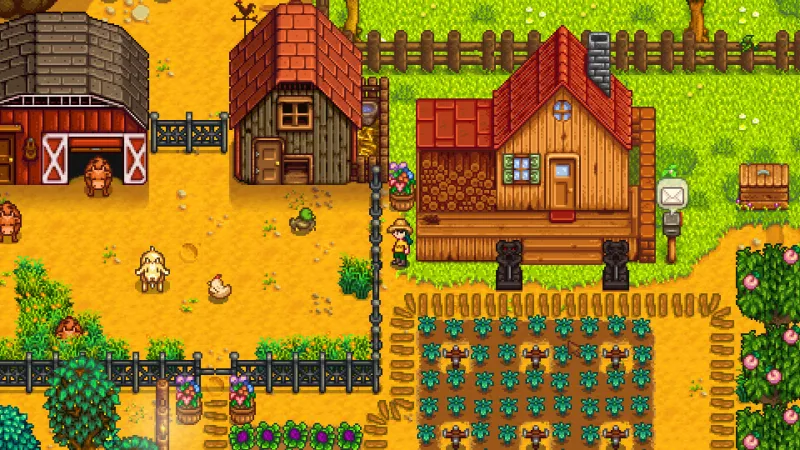
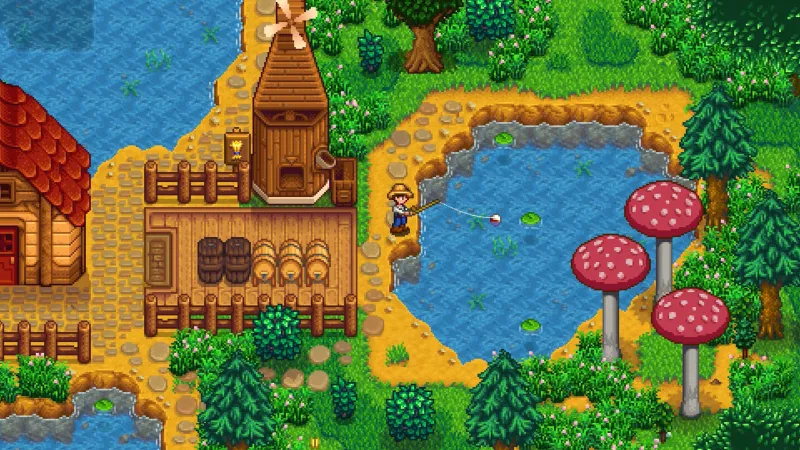
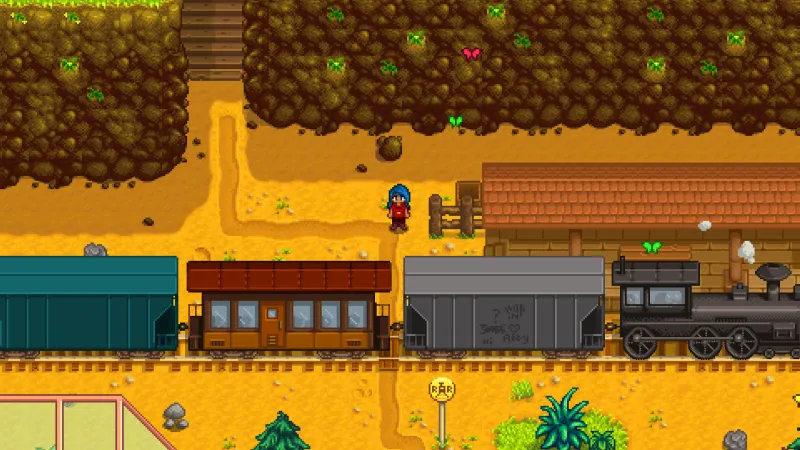
The virtual, resplendent lands of Stardew Valley are magical. Pixeled auburn grass rustles quietly as fiery fall leaves spiral in the air. Banjos pluck away in the background as the player delivers goods to townspeople. There are shopkeepers’ daughters to romance, hidden caverns filled with skeleton monsters, orb-like forest sprites, and town drunks. When you water parsnips in the early morning, the world feels quiet, and when you rush home from the mine in the wee hours of the night, it feels busy. The valley is full of life.
Players assume the role of a newly minted farmer whose late grandfather has bequeathed them a tract of land in his will. The player-character moves to the small town called Stardew Valley to start a life free from the woes of the nine-to-five office grind. Since its release, the game has become a seminal work that explores a life free of the drudgery associated with modern life.
“[Stardew Valley] feels scrappy, but in a charming way, I think,” Barone said when asked why he thinks the game has maintained its appeal over the years. “The theme of Stardew Valley itself is about returning to a more authentic way of living, more natural. I think that speaks to people across all ages. Especially as the world gets crazier and crazier. I think people look to Stardew Valley as an escape and a return to what is really human and the kinds of goals that we naturally have.”
The game Eric Barone published in 2016 is not the same Stardew Valley players enjoy today. The day he released it, Barone immediately began improving it by releasing bug fixes and new content. That ongoing work, in a sense, has never stopped. Over the course of 10 years, Barone has released six major patches. These additions have introduced new marriage candidates, additional regions to explore, and other changes to keep the game running smoothly. Looking back, I asked Barone if there were any favorite updates he released.
Stardew Valley
“I would say 1.6, the most recent update. Maybe I’m always just most excited about the most recent update. But, well, I’ll say two,” Barone said as he paused. “The first [1.1] update was also notable, because it came out right after [release]. I started working on it basically right after Stardew came out. It was still completely solo, and the game was not yet in multiple languages. It didn’t have mobile versions. It was so much easier to work on the update. It felt very real and fresh, and if I had an idea, I could just put it in, it’s ready to go. That era of development was more fun. Now there’s a lot of overhead with any sort of new thing added to the game.”
In a world where players are used to major game studios stuffing their games with microtransactions, battle passes, and paid updates, Barone’s approach to game development is rare. Although the updates have introduced loads of new content to the game, he hasn’t charged for a single one. Online, fans have a tendency to put Barone on a pedestal, or at the very least, openly and consistently express their gratitude. I asked him what he thinks about all the praise from fans. He tries, “not to dwell on it too much.”
“I don’t think of myself as some great, moral person. I don’t think I ever would, no matter what, because I just feel like it’s not a good way to think about yourself. It’s always better to be thinking you could do better,” Barone said.
“But I guess the truth is, I just genuinely value the love of the players more than the money that I could squeeze out of everyone. I just know that that would not bring me as much happiness as being beloved by the community. So it’s like, to me, it’s kind of a no-brainer. You might even call it selfish, because I’m really doing what is going to make me the happiest. You know, you can either chase the dollar or you can chase the respect and admiration of the community. And [chasing the community] is just what I prefer. That makes me feel better than having money.”
Stardew Valley
As Barone got to work improving Stardew Valley and chasing that admiration, he had to contend with the pressures a newly coalesced fandom brought to his own decisions when prioritizing what to add to the game. He likened the balance between listening to the fans and following his own intuitions to walking on a “tightrope.”
“The way I lean mostly is that I should do what I want. I think that even if the fans don’t realize that, that’s what they’re going to want, because they liked Stardew Valley originally, which was completely my idea. I didn’t have any fan input whatsoever, except maybe a few comments on my dev blog back in the day, but that’s the game that people fell in love with. If I now just start listening to the fans, then they might think that that’s what they want, but I think in reality, they would not be happy with the result. So I’m cognizant of that. But at the same time, I will listen to what people say, and if I think it’s a good idea that lines up with my wants and it’s something I feel like doing, then I might prioritize that. Or I might, you know, take ideas, even from the community, that I’m like, ‘Hey, that’s a good idea.’ So I’m not completely closed off to the possibility, but it has to pass through my filter.”
Given the pressure a large following can put on the creation of a game, I ask if he ever had a change he wanted to make to the game, but was too scared to. He says there are probably “many” and tells me about one specific instance where he was too nervous to add previously married characters as marriage candidates to the game.
“I mean, one thing I have mentioned before, which I kind of was half joking about. It was like, people want to marry Caroline or Robin or Demetrius, and in order to do that, you would have to break up families in town. And personally, I’m against that on a moral level. But I feel like in a sandbox game, you should be able to do wicked things and then face the consequences. I wouldn’t just make everyone be totally chill about it. Everyone would hate you. It would cause a lot of chaos and disaster and suffering, and people would be angry, and you would ruin the family. I would be open to doing something like that, but I wouldn’t baby people about it. There would be very serious consequences. But then part of me is like, ‘Well, maybe this is just too real.’ Maybe Stardew Valley is supposed to be, to some degree, an escape from those kinds of things. It’s too realistic, you know?”
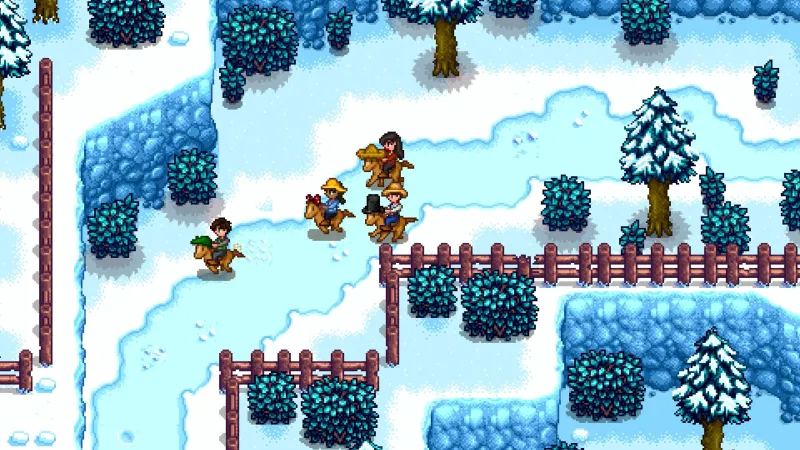
Stardew Valley
Barone has been fine-tuning his own filters for what to add (or not to add) to the game over the past 10 years and even in the years leading up to the game’s release. To celebrate Stardew’s 10th anniversary, he and his team released a video showing previous versions of the game with commentary on some of the changes he made over the years. One part of the video showed a scrapped concept for an underground goblin village.
“It was a lot of trial and error. I had ideas. I’d kind of just put them in, and then I’d just test it out and play it,” Barone says when asked about his process for deciding which concepts to implement or not. “If it didn’t feel good, that would start to gnaw at me. And then after a while, I’d eventually be like, ‘You know, what am I going to do? This is a disaster.’ That was kind of the case with the mines, with the goblin villages, and everything. I was like, ‘This is just not feeling good.’ And then at some point, I just made the very difficult decision to scrap it all, which was extremely difficult. I didn’t want to do that. That was months and months of work that I had to cut. But sometimes, when you know that it’s not good, it can be a relief to cut it and then maybe find something that is good. I’d say it’s just trial and error. I just kind of do it. It’s almost like intuitive game development. I just kind of do what comes to mind, whatever whim I have, and then I’ll put it in. A lot of game developers, they’ll put things in with placeholder art. I don’t do that. I will do everything. I’ll do the whole thing and put it in, and then I’ll realize I don’t like it, and then cut it all.”
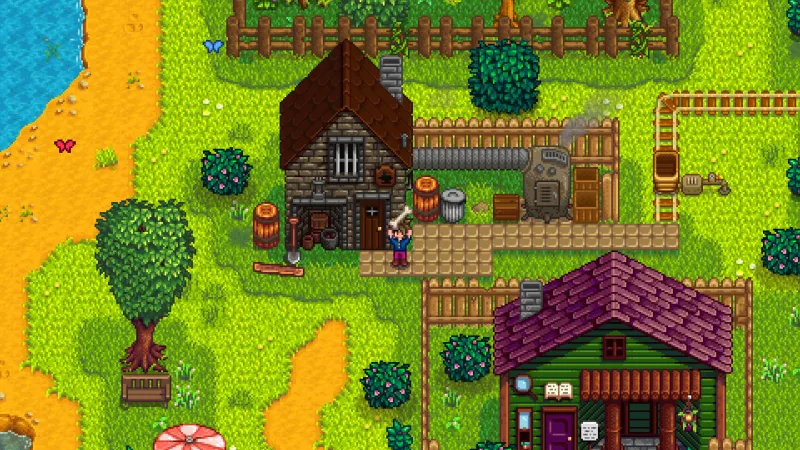
Stardew Valley
Other World Connections
Stardew Valley is a grounded game in a sense. It is literally about working with the land and developing human relationships with the local townspeople. However, Barone kept returning to a general idea of “intuitive” game development and the ineffable ways that art can move people. In an interview with IGN, Barone talked about his appreciation for the late director David Lynch, and we dove into the topic further.
“I believe that [David Lynch] has, and I think all great artists have, this connection to the other world, I would call it. I think it’s where the creativity actually comes from,” Barone says when speaking of Lynch.
“It’s not demonic,” Barone continues. “I think that’s just where creativity comes from, really. It speaks to the intuitive, mysterious nature of creativity. And I’ve often wondered, ‘Where does music come from? How do I compose music?’ It’s not a logical process. It just kind of comes out of nowhere. To me, it’s very mysterious. It’s supernatural. It can’t really be explained. I don’t think science can explain it.”
Bringing this world to other people seems to animate Barone. Even after more than 10 years of working on Stardew Valley, his voice brightens, and I see him lean in as he talks.
“Ultimately, I just want to bring magic to people. I want to delight people with magical feelings. It’s the same way that when I played games when I was a kid, I felt that, – and not just games but other things, movies or books or whatever, – but [games] gave me this special magical feeling that it’s almost hard to describe. It’s like when you’re looking at the horizon, and the sun is coming down, there’s a certain feeling you have. It’s this ethereal feeling that it just makes… I don’t… It’s so hard to describe.”
Barone continues to elaborate on what he meant by this ethereal connection to another world.
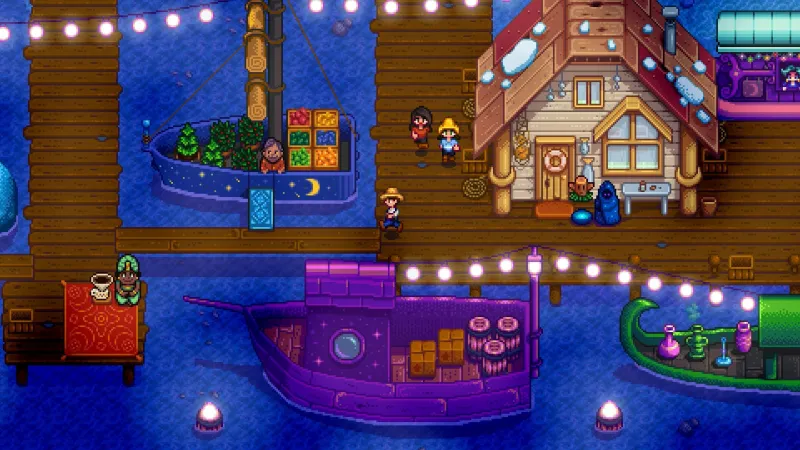
Stardew Valley
“I think kids are very attuned to that sort of thing. Like they see gnomes and they see things, because I think they’re more connected to that creative, spiritual side, in a way. We kind of lose that as adults, and I think it’s sad. I want to at least create one area where adults can kind of suspend their disbelief and feel that again for a little bit. And I think I achieved that sometimes in Stardew Valley, and that’s what I’m hoping to continue to achieve with [my next game] Haunted Chocolatier.”
Announced in 2021, Haunted Chocolatier is the next game from Barone, where you play as a chocolatier living in a haunted castle and gather ingredients to make and sell chocolate. In the process of making the game, Barone will be able to create a new world and explore new themes in its darker, confectionery-inspired world.
To Barone, the humanity of artistic expression is core to his work, whether he’s talking about Haunted Chocolatier or Stardew Valley. As a former solo developer, he has been able to bring his own touch and hand to every aspect of his work, whether it’s learning pixel art or composing music. He mentions this when we speak about the growing role of AI in game development.
“I think anything’s lost when you use AI for any creative thing, any step of the way – unless it’s being used for very specific zoomed-in cases, maybe. You’re offloading creativity to an algorithm, which I think is always gonna undermine the pure and authentic human element of what you’re doing. So for me, as someone who wants to express myself in an artistic way, I wouldn’t ever want to use AI for any sort of creative thing, because it’s beside the point of what I’m doing. My goal is to express myself in a creative way. Why would I let an AI do that for me? At the very least, let another human being express themselves if you need help. That’s probably what I would say. There are plenty of humans out there that would like an opportunity to express themselves. I feel like that should take priority over a soulless machine.”
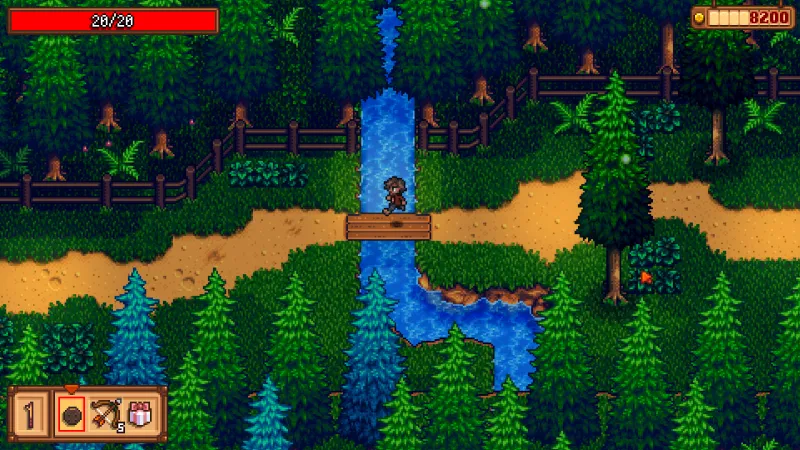
Haunted Chocolatier
Juggling Chocolate And Produce
Although Eric Barone chases a sort of spirituality and otherworldliness when making video games, he still must contend with the day-to-day work it takes to make and produce his games. He and his team are working on two games at the moment: the Stardew Valley 1.7 update and the unreleased Haunted Chocolatier. Barone tells me working on two projects simultaneously is going “okay.” He says he tries to spend five days a week working on Haunted Chocolatier and two on Stardew Valley.
“It’s kind of hard to switch gears sometimes, to be honest, but it’s just what I’ve got to do,” Barone says. “It’s just another challenge, because I have two games that I’m working on. I just have to do it. It’s not my preference, but it’s just what needs to be done.”
It’s not just that Barone must manage working on two games at once. Stardew Valley has become a global hit, and that has introduced a lot more responsibilities in Barone’s day-to-day work life. There was a sold-out Stardew Valley concert series. There’s a board game and a cookbook. He has fans who know what jacket he likes to wear now. He can’t live the quiet life he did when making Stardew Valley.
“It’s a lot harder than when I was making Stardew Valley,” Barone says. “I’ll be honest. [During the making of] Stardew Valley, I was a nobody. Nobody knew who I was. I didn’t get fan mail. I didn’t have business people asking me for this or that all the time. I could just literally lock in and work.”
Now, Barone has people – like reporters from Game Informer – filling his days with requests and distracting him from game development. He told me he’s just the kind of person who needs to work without disturbances.
“I need to just disappear, go into a cabin, and work without distraction. So it is very difficult and distracting, I’ll be honest, to have Stardew Valley and have people sending me fan mail. I appreciate that people love the game so much. But it is true that it’s difficult to juggle all those things and to be able to fully lock in.”
Haunted Chocolatier
Although it might make creating Haunted Chocolatier more difficult, Barone says he just wants “to keep the good times rolling” when it comes to Stardew Valley. He mentions an entire list of possible features and ideas he might want to add in the 1.7 update. He would like more interactions between married characters and wants to add reasons for people to go back and re-experience old festivals. He also mentioned wanting to flesh out some of the current game systems, like the Quest Board and Special Orders Board, as well.
“There are a lot of people who still love Stardew Valley, and that’s a large audience. It would be kind of a shame to just abandon that. I take that seriously. That’s a rare position to be in to have so many people interested in your game and wanting to continue to play it 10 years after release.”
The way Barone speaks of it, it sounds like the release of Haunted Chocolatier is still a ways off. He described his current stage as being “knee deep” in development of the game. Stardew Valley took him four and a half years to create with no distractions. He doesn’t have that luxury now. Additionally, he described the scope of Haunted Chocolatier as being much larger than Stardew Valley.
“It’s way bigger than Stardew Valley, at least in terms of the amount of maps, the amount of monsters, the depth to the whole item system, and all the equipment slots and all the stuff like this. Everything is cranked up.”
Artistically, Haunted Chocolatier is allowing Barone to explore whatever he wants in his next game. This includes a darker world that’s maybe a bit more unsettling when compared to the cheery lands of Stardew Valley.
“I’m interested in exploring a darker theme, darker atmosphere. […] The ghosts, the haunted nature, the castle, allows for a lot of interesting, creative things that I can do that are kind of creepy, like not totally horrifying, but maybe slightly, you know, creepy stuff. I want people to be delighted by things that are unexpected and that they’re kind of like, ‘Wow. Like, I have no idea what’s going on, but I like it.’”
Although it might not provide the faster gratification that can come with a Stardew Valley update, Haunted Chocolatier is still core to Barone’s overall trajectory as a game developer and as an artist who wants to express himself through video games now and in the future.
“There are other things I want to share, there are other ideas I have, there are other themes I want to explore, just to fully express myself as a creator,” Barone said. “So that’s why I feel like I need to make Haunted Chocolatier and beyond. It’s part of my own need to fully express myself while I’m on this earth.”

Leave a Reply